Famous Painting Fuse Bead Patterns: 8 Free (Hokusai, Van Gogh)
・ mamepix editors

Start with eight free mamepix patterns, from Hokusai's Great Wave to Van Gogh's Sunflowers. Each fits on one 29-peg board, so with 2.6 mm beads you get a palm-sized masterpiece of about 6–7.5 cm.
8 free famous painting patterns (size and bead count)
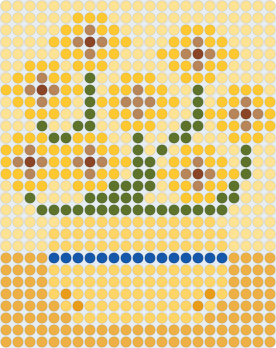
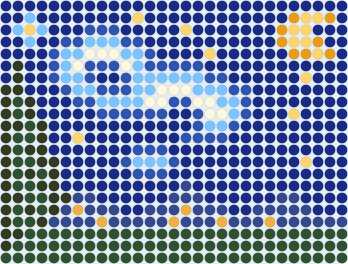
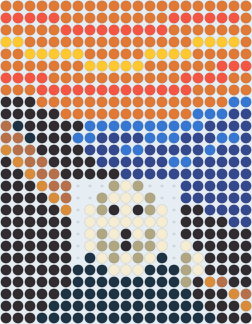
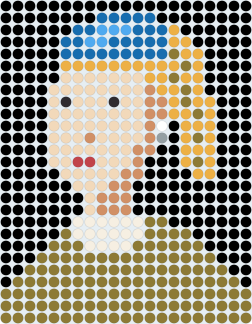
mamepix has eight free famous painting patterns: The Great Wave off Kanagawa, Red Fuji, The Starry Night, Sunflowers, Girl with a Pearl Earring, Mona Lisa, The Scream and Composition (Mondrian). Each uses 540–670 beads in 5–12 colors and fits on one 29-peg board.
Listed from fewest colors. Every pattern has color codes and bead counts per color, and a printable PDF on its page. See all eight in the famous paintings collection.
| Pattern | Size (beads) | Finished (2.6 mm) | Beads | Colors |
|---|---|---|---|---|
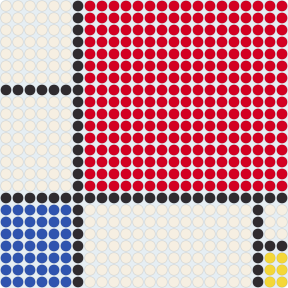
| Composition (Mondrian) | 24×24 | about 6.2×6.2 cm | 576 | 5 |
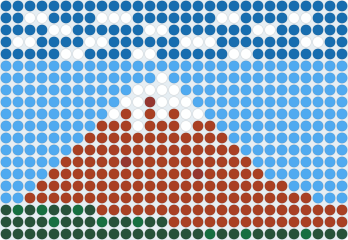
| Red Fuji (Hokusai) | 29×20 | about 7.5×5.2 cm | 580 | 7 |
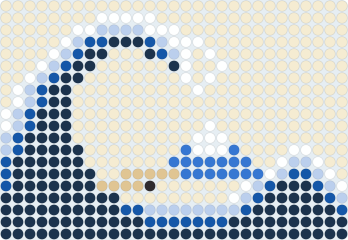
| The Great Wave (Hokusai) | 29×20 | about 7.5×5.2 cm | 580 | 8 |
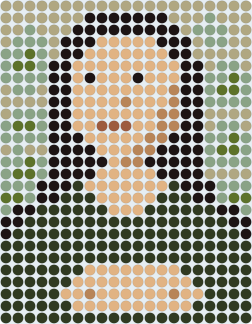
| Mona Lisa (Leonardo) | 21×27 | about 5.5×7.0 cm | 567 | 8 |
| Sunflowers (Van Gogh) | 23×29 | about 6.0×7.5 cm | 667 | 9 |
| The Starry Night (Van Gogh) | 29×22 | about 7.5×5.7 cm | 638 | 10 |
| The Scream (Munch) | 21×27 | about 5.5×7.0 cm | 547 | 11 |
| Girl with a Pearl Earring (Vermeer) | 21×27 | about 5.5×7.0 cm | 567 | 12 |
New to this? Start with Mondrian or Red Fuji
The easiest is Composition (Mondrian): black lines plus red, blue and yellow. Five colors and only straight lines, so you never wonder where a bead goes, and it doubles as a coaster.
Next, try Red Fuji, where sky, mountain and forest are big blocks of color. Once you are comfortable, move on to the fine white spray of The Great Wave, the swirling sky of The Starry Night, or the two-tone shading of Girl with a Pearl Earring.
Tips for a clean result
- Work with color codes: turn on "Show color codes" on the pattern page or print the PDF, and place one color at a time
- Place large areas first: lay the sky and background first and the small whites (spray, clouds, the pearl) last
- Keep similar colors apart: store cream and white, or navy and blue, in compartments far apart
- Iron both sides: iron the front and back, then cool under a weight so it stays flat
Display ideas: frames, coasters, magnets
Each pattern is one pegboard in size, so it fits a 3.5×5 inch or postcard frame like a tiny museum piece. A white mat makes the pixel colors stand out.
For framing, open the pattern in the Pattern Maker and add an outline for a white or black border. Mondrian and Red Fuji make great coasters with felt on the back, or small magnets.
Famous paintings and copyright
In Japan, copyright in a painting generally ends 70 years after the artist's death. All eight works here are in the public domain: Hokusai died in 1849, Van Gogh in 1890, Vermeer in 1675, Leonardo in 1519, and Munch and Mondrian in 1944.
The mamepix patterns are our own pixel interpretations of these paintings. Make them for yourself or as gifts, but please don't redistribute or sell the patterns themselves. We don't make patterns of works whose artists died less than 70 years ago (such as Dalí or Picasso), or of characters.
Want to turn another artwork into a pattern?
The Pattern Maker turns an image into a pattern with bead counts, free. Choose "Drawing" as the picture type for crisp blocks of color. For paintings, use images of public-domain works.
FAQ
Which famous painting pattern is the easiest?
Composition (Mondrian): black lines with red, blue and yellow, 5 colors and 576 beads, about 6.2 cm square with 2.6 mm beads.
How many beads do the painting patterns need?
Between 540 and 670 beads. Each fits on one 29-peg board and comes out about 6–7.5 cm with 2.6 mm beads.
Is it OK to make famous paintings in beads?
Works whose artists died more than 70 years ago are in the public domain and free to recreate. All mamepix painting patterns are original interpretations of public-domain works.
Can I make them with 5 mm Perler beads?
Yes. Choose Perler under "Your beads" on the pattern page to see the nearest Perler colors and the size at 5 mm (about twice as big).